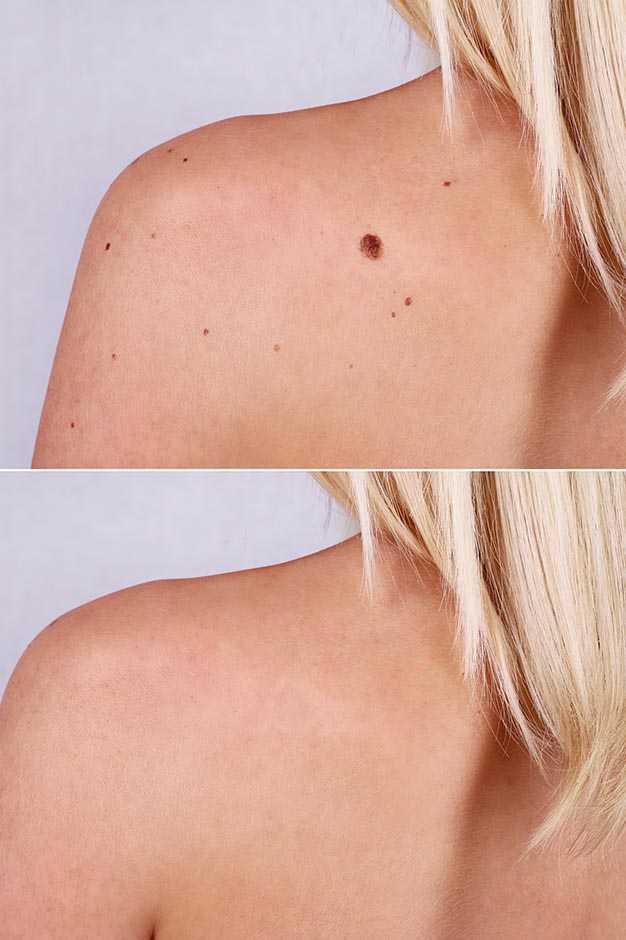
Who can undergo mole treatment?
Individuals whose mole has suddenly started to grow when it was 1–2 cm in diameter, or whose mole is located in a visible area and is aesthetically bothersome.
Mole removal is commonly requested because the mole causes cosmetic concern.
In addition to being an aesthetic concern, moles may also be associated with serious health conditions. They should therefore be evaluated carefully. In particular, all suspicious moles larger than 2–3 mm should be sent for pathological examination.
Mole treatment or mole removal is performed under local anaesthesia, so the patient does not feel pain or discomfort. The procedure generally takes 15–20 minutes depending on the size and number of moles.
Will there be a scar after mole removal?
A very fine, line-shaped mark may remain in the treated area. At the end of the wound-healing process, this mark fades to a colour close to the skin tone and becomes difficult to notice.
Is mole removal risky?
Mole removal has no known inherent risk when properly indicated. It also helps prevent serious conditions that may arise from suspicious lesions. The cancer risk may increase especially when dark-coloured moles are exposed to harmful sunlight. Early treatment can help reduce potential risks associated with suspicious moles.
What happens after mole treatment?
- The patient can continue daily life.
- After the procedure, the wound is covered with very small, waterproof dressings.
- The patient may shower, exercise and continue daily routines on the same day without restriction.
- Steri-strip tapes are used for 15–20 days to help prevent widening of the scar.
- Scar creams may be started after 20 days.
- Sunscreen should be used in outdoor environments.