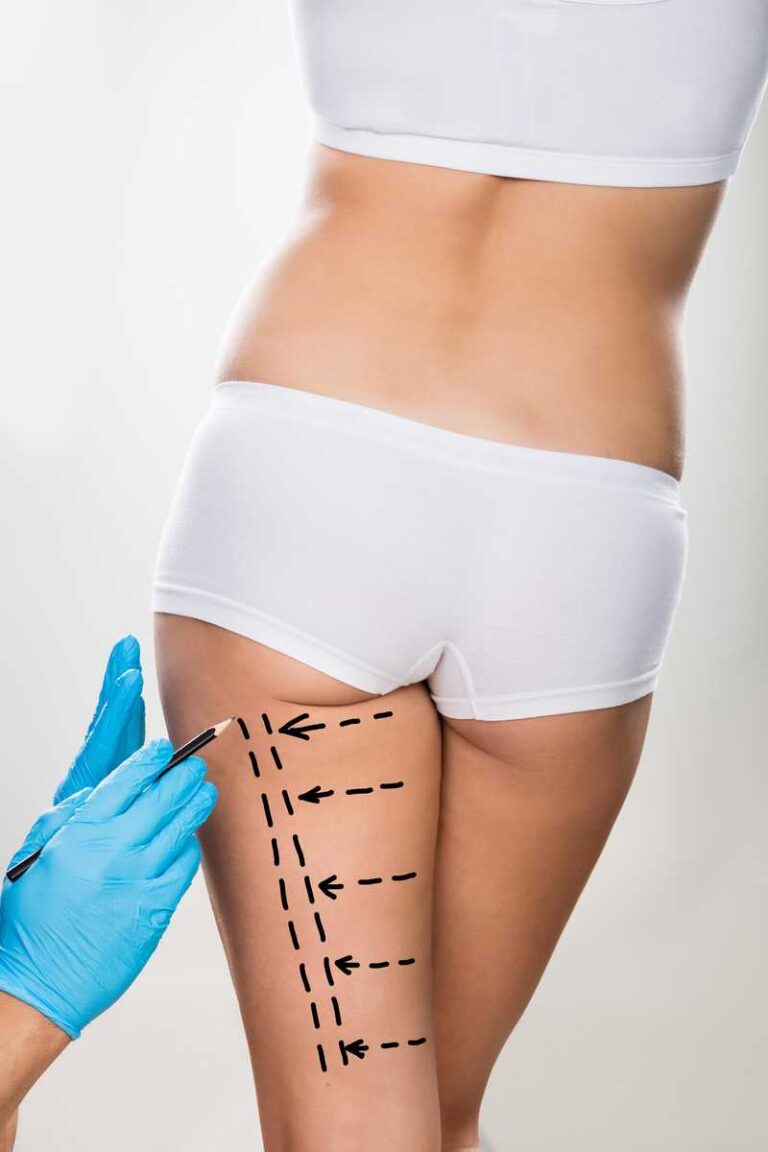
Who should consider thigh lift surgery?
Women over 40 who develop increased laxity on the inner and upper thighs after weight fluctuations, as well as individuals who experience early loosening due to their skin type, may be suitable candidates.
One of the concerns that most bothers women is sagging and rippling on the inner thighs. Frequent weight gain and loss, lack of exercise, and aging accelerate laxity in this area.
This sagging and rippling on the inner thighs is not only aesthetically bothersome; it can also cause functional discomfort by creating friction while walking.
Thigh Lift surgery removes excess skin and fat that develop on the upper and inner aspects of the thighs.
In thigh lift surgery, the scars are positioned along the inner thigh in a horizontal line or may be accompanied by a vertical scar. The surgical plan depends on the amount of skin excess and the thickness of the fat layer. Liposuction can occasionally be added to the operation. The final scar is not visible from the front when the patient is standing.
Is there a non-surgical solution for the thigh area?
Regular exercise and avoiding weight gain are helpful for preventing sagging in the inner thighs. In addition, lymphatic drainage and radiofrequency treatments may support skin tightening and help maintain the thigh area.
What should be considered after thigh lift surgery?
- The patient is usually discharged on the same day.
- Dressings remain over the stitches during the first 2 days.
- Since the sutures are placed under the skin, they do not need to be removed.
- The patient may shower 2 days after the procedure.
- For the first 3 weeks, prolonged standing and excessive walking should be avoided.
- At the end of the 3rd week, sports other than running may be resumed.
- All kinds of activities are allowed from the 6th week onward.
- Once the area heals uneventfully, scars become much less noticeable after about 6 months.